- You apparently don't get contemporary in-flight entertainment on United flights to Australia. The fare for my trip included some movie with Richard Gere as a 20-something; Wall Street; Shrek (the original); and some movie with Sandra Bullock crying a lot and hugging two young girls. Fortunately, I chose to read Bill Bryson's In a Sunburned Country and was enormously entertained instead.
- Australian customs and immigration is far more assertive and aggressive even than American customs. Dogs running up and down the waiting lines, really intense questioning about fruits, veggies, etc. It was not a speedy process.
- The flight attendant on the short hop from Sydney to Canberra was 6'5" and named Kylie. Somehow, this seemed appropriate.
- Apparently, Australian magpies will play the role of the American rooster in this adventure. They sing at 6AM, with a call that sounds not unlike R2D2 short-circuiting.
- Regrettably, the housing stock in Australia appears to have been designed by the same folks who designed California's--that is, under the impression that it never gets cold here. So my room loses heat at an incredible rate at night. And it is not warm here either; temps top out around 50-55 degrees during the bright sunny day, but dip below freezing at night. I'm going to have to buy some additional blankets this evening, I think.
Monday, August 13, 2007
Down Under
I arrived in Australia yesterday, and am slowly getting myself up and running. A few notes:

Wednesday, August 8, 2007
San Millan de la Cogolla -- June 2, 2007
Here are a few pictures from around San Millan de la Cogolla, in the Rioja region. San Millan is famous as the "birthplace of the Spanish language," if memory serves because one of the first monks in Spain to write in the vernacular lived in one of the area's two monasteries, in around the eleventh century or so.
The first pictures were taken at Yuso, one of the two monasteries (the other, Suso, was closed). The latter were taken on the way back to our hotel in Haro, when we stopped off at a berm of wild poppies, which are everywhere in Spain in early June.

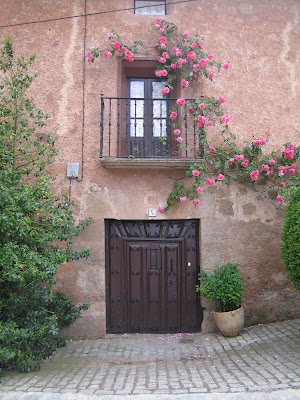


The first pictures were taken at Yuso, one of the two monasteries (the other, Suso, was closed). The latter were taken on the way back to our hotel in Haro, when we stopped off at a berm of wild poppies, which are everywhere in Spain in early June.


Tuesday, August 7, 2007
Burgos Cathedral -- June 1, 2007
I learned a thing or two about my patron saint today...
 This picture shows the main entrance to Burgos Cathedral, one of the greatest in Spain. We hit it on the first day of our trip, some three hours after I arrived in Madrid from New York on an overnight flight. Mercifully, L. did all of the driving up from Madrid (two hours) so I was able to sleep in the car and actually enjoy the cathedral. Even on a trip that included the grand Cathedral at Santiago de Compostela, this cathedral was a high point, especially its exquisite treasury of medieval art.
Much as you can't get very far around Florence without running into all kinds of statues of Saint Sebastian getting shot full of arrows, you can't get far around Burgos without running into paintings of Saint Jerome (a.k.a. San Jeronimo). Fortunately (or unfortunately, depending on your point of view), Saint Jerome didn't meet with a grisly death, so instead he's usually depicted looking tormented, reading and/or translating the Bible, in the vicinity of a skull (symbol of meditation). For his labors, he is now patron saint of archivists, librarians, and students. So it's somewhat appropriate, given my impending journey, to devote this post to the many terrific depictions of Saint Jerome that fill Burgos Cathedral:


As cool as St. Jerome is, however, he can't hold a candle to the best piece of art in the treasury. Ladies and Gentlemen, I am proud to present...
Disco Jesus!

I mean, is there really any doubt that this version of Jesus is not just bringing light and truth, but bringing it?
 This picture shows the main entrance to Burgos Cathedral, one of the greatest in Spain. We hit it on the first day of our trip, some three hours after I arrived in Madrid from New York on an overnight flight. Mercifully, L. did all of the driving up from Madrid (two hours) so I was able to sleep in the car and actually enjoy the cathedral. Even on a trip that included the grand Cathedral at Santiago de Compostela, this cathedral was a high point, especially its exquisite treasury of medieval art.
Much as you can't get very far around Florence without running into all kinds of statues of Saint Sebastian getting shot full of arrows, you can't get far around Burgos without running into paintings of Saint Jerome (a.k.a. San Jeronimo). Fortunately (or unfortunately, depending on your point of view), Saint Jerome didn't meet with a grisly death, so instead he's usually depicted looking tormented, reading and/or translating the Bible, in the vicinity of a skull (symbol of meditation). For his labors, he is now patron saint of archivists, librarians, and students. So it's somewhat appropriate, given my impending journey, to devote this post to the many terrific depictions of Saint Jerome that fill Burgos Cathedral:


As cool as St. Jerome is, however, he can't hold a candle to the best piece of art in the treasury. Ladies and Gentlemen, I am proud to present...
Disco Jesus!

I mean, is there really any doubt that this version of Jesus is not just bringing light and truth, but bringing it?
Thursday, August 2, 2007
Santillana del Mar -- June 3, 2007
Santillana del Mar is a small town in the north of Spain which is, its name to the contrary, not located on the ocean. It's an extremely well preserved medeival town, near the famous (and closed to the public) Altamira Caves, which means it gets quite a bit of tourist traffic during the day. It empties out at night, however, which is when we experimented with night photography:


 For some reason, the black and white ones always turn out the best at night. I think it's because they capture the two-headed nightwalkers that the color shots just can't...


 For some reason, the black and white ones always turn out the best at night. I think it's because they capture the two-headed nightwalkers that the color shots just can't...
Tuesday, July 31, 2007
Spain's War on Speed, Part II
No photos this time, just a friendly travel advisory:
You know how, in the U.S., you'll often see signs that say "speed monitored by radar," and it's just kind of a general warning that a cop might be sitting behind a berm waiting to catch you for going too fast? Well, in Spain those signs actually mean something. All over the country on the motorways, Spain has installed little boxes that monitor your speed and take pictures of your license plate if you go too fast. They then mail you a speeding ticket, and deduct a set number of "points" from your license. (Enough deductions, and you can't drive anymore.) However, as part of the surveillance law that enabled these boxes, the authorities must notify you of any unmanned radar installation. So when you see a big sign warning you to slow down, you can be sure that one of these radar-camera boxes is about a half-mile down the road.
The good news is that once you figure out what the boxes look like, you'll know when you've passed one of them. Then, you can resume whatever speed you were traveling before.
You know how, in the U.S., you'll often see signs that say "speed monitored by radar," and it's just kind of a general warning that a cop might be sitting behind a berm waiting to catch you for going too fast? Well, in Spain those signs actually mean something. All over the country on the motorways, Spain has installed little boxes that monitor your speed and take pictures of your license plate if you go too fast. They then mail you a speeding ticket, and deduct a set number of "points" from your license. (Enough deductions, and you can't drive anymore.) However, as part of the surveillance law that enabled these boxes, the authorities must notify you of any unmanned radar installation. So when you see a big sign warning you to slow down, you can be sure that one of these radar-camera boxes is about a half-mile down the road.
The good news is that once you figure out what the boxes look like, you'll know when you've passed one of them. Then, you can resume whatever speed you were traveling before.
Monday, July 30, 2007
Spain's War on Speed, Part I
Here's a clever idea:
 Photo taken on the road between Fuente De and Potes, Cantabria, Spain, June 5, 2007.
These mechanisms are all over the north of Spain. To reduce the number of drivers who speed through little towns, these traffic lights are attached to a radar gun that automatically turns them red if the approaching car is traveling above the posted speed limit. Once the driver slows to the permitted speed, the light turns to a flashing amber.
While very annoying, I think this is actually one of the most effective traffic control devices I've ever seen. Lots of American small towns could really make use of them, I think--though then again it would probably make it a lot harder for the local police to issue tickets!
 Photo taken on the road between Fuente De and Potes, Cantabria, Spain, June 5, 2007.
These mechanisms are all over the north of Spain. To reduce the number of drivers who speed through little towns, these traffic lights are attached to a radar gun that automatically turns them red if the approaching car is traveling above the posted speed limit. Once the driver slows to the permitted speed, the light turns to a flashing amber.
While very annoying, I think this is actually one of the most effective traffic control devices I've ever seen. Lots of American small towns could really make use of them, I think--though then again it would probably make it a lot harder for the local police to issue tickets!
Thursday, July 26, 2007
Gaastra, Michigan -- May 28, 2007
This is the first of a series of posts I hope to do featuring pictures from various travels I've done. I enjoy photography, though I'm not particularly good at it. So any tips on improving the photographs (in the comments) would be greatly appreciated!
This post contains four pictures from the town of Gaastra and its surroundings, in the Upper Peninsula of Michigan, which I visited back at the end of May on a swing through the Midwest. The area has a generally depressed farming economy and a few remnant mining and timber operations. Like Vilas County, just over the border in Wisconsin, it has begun to transition into a service-vacation economy; the area is dotted with small glacial lakes and kettle moraines, which make it prime location for summer cottages and recreation for Midwestern city-slickers.
This picture was taken in the town of Gaastra in the local playground. This swingset was the best-maintained piece of equipment in the place. Tire swings were pretty common when I was a kid, though today they're considered dangerous because water collects in them and breeds mosquitoes and other nasty things. (Here in San Francisco, all of the playgrounds are nice and safe and made out of colored plastic.) But not in Gaastra, where the tire swing still reigns supreme:

This next picture was taken just outside of town. The soil in this part of the country is littered with rocks, courtesy of the retreating glaciers of the last Ice Age. Farmers had to clear them all by hand. Sometimes they used them to make neat stone walls like this one:

However, typically there were so many of them that they would also just create enormous piles of rocks in the middle of the field and just farm around them:

(Incidentally, the above setting is one of my favorites in the area. The light wasn't ideal when I got there, but I plan to go back and take a few more next time I'm in the area.)
Finally, there's this shot. For some reason, barns with smiley-faces are a fairly common sight in the Great Lakes region (also watertowers with smiley-faces). So are barbed wire fences. So this shot brings the Midwest's two great tastes together, in one "good fences make good neighbors" taste sensation...

This post contains four pictures from the town of Gaastra and its surroundings, in the Upper Peninsula of Michigan, which I visited back at the end of May on a swing through the Midwest. The area has a generally depressed farming economy and a few remnant mining and timber operations. Like Vilas County, just over the border in Wisconsin, it has begun to transition into a service-vacation economy; the area is dotted with small glacial lakes and kettle moraines, which make it prime location for summer cottages and recreation for Midwestern city-slickers.
This picture was taken in the town of Gaastra in the local playground. This swingset was the best-maintained piece of equipment in the place. Tire swings were pretty common when I was a kid, though today they're considered dangerous because water collects in them and breeds mosquitoes and other nasty things. (Here in San Francisco, all of the playgrounds are nice and safe and made out of colored plastic.) But not in Gaastra, where the tire swing still reigns supreme:

This next picture was taken just outside of town. The soil in this part of the country is littered with rocks, courtesy of the retreating glaciers of the last Ice Age. Farmers had to clear them all by hand. Sometimes they used them to make neat stone walls like this one:

However, typically there were so many of them that they would also just create enormous piles of rocks in the middle of the field and just farm around them:

(Incidentally, the above setting is one of my favorites in the area. The light wasn't ideal when I got there, but I plan to go back and take a few more next time I'm in the area.)
Finally, there's this shot. For some reason, barns with smiley-faces are a fairly common sight in the Great Lakes region (also watertowers with smiley-faces). So are barbed wire fences. So this shot brings the Midwest's two great tastes together, in one "good fences make good neighbors" taste sensation...

Subscribe to:
Comments (Atom)